

Planning building work near a shared wall or boundary? Then you need to get one thing right from the start: your party wall notice. At FPWS (First for Party Wall Surveyors), our experienced surveyor and writer team has handled thousands of these cases. And we see the same slip-ups again and again.
This guide breaks down the Top 10 Party Wall Notice Mistakes in 2026, so you can avoid stress, delays, and costly disputes. A small error on a party wall notice can stop your whole project. It can also upset your neighbour and lead to legal trouble. The good news? Every mistake here is easy to avoid once you know what to look for.
Let’s make sure you get it right the first time.
Quick Answer: What Are the Most Common Party Wall Notice Mistakes?
Short on time? Here is the snappy version.
The most common party wall notice mistakes in 2026 are:
- Not serving a notice at all
- Serving the wrong type of notice
- Getting the notice period wrong
- Forgetting to notify every adjoining owner
- Writing a vague work description
- Leaving out plans for excavation notices
- Serving the notice too late
- Putting the wrong names or addresses on the notice
- Misreading your neighbour’s silence as consent
- Letting the notice expire before work starts
Each one can delay your build or invalidate your notice. Read on for simple, expert advice on how to dodge them all.
What Is a Party Wall Notice?
A party wall notice is a legal letter. You send it to your neighbour before you start certain building work.
It is required under the Party Wall etc. Act 1996. This law covers England and Wales. It protects both sides when work happens near a shared structure.
In this law, you are the building owner. The neighbour affected by your work is the adjoining owner.
You usually need a party wall notice for things like:
- Loft conversions that touch a shared wall
- Rear or side extensions near a boundary
- Digging foundations close to a neighbour’s home
- Building a new wall on or along the boundary line
- Removing a chimney breast on a party wall
If your work falls under the Act, the notice is not optional. It is the law. Now let’s look at where people go wrong.
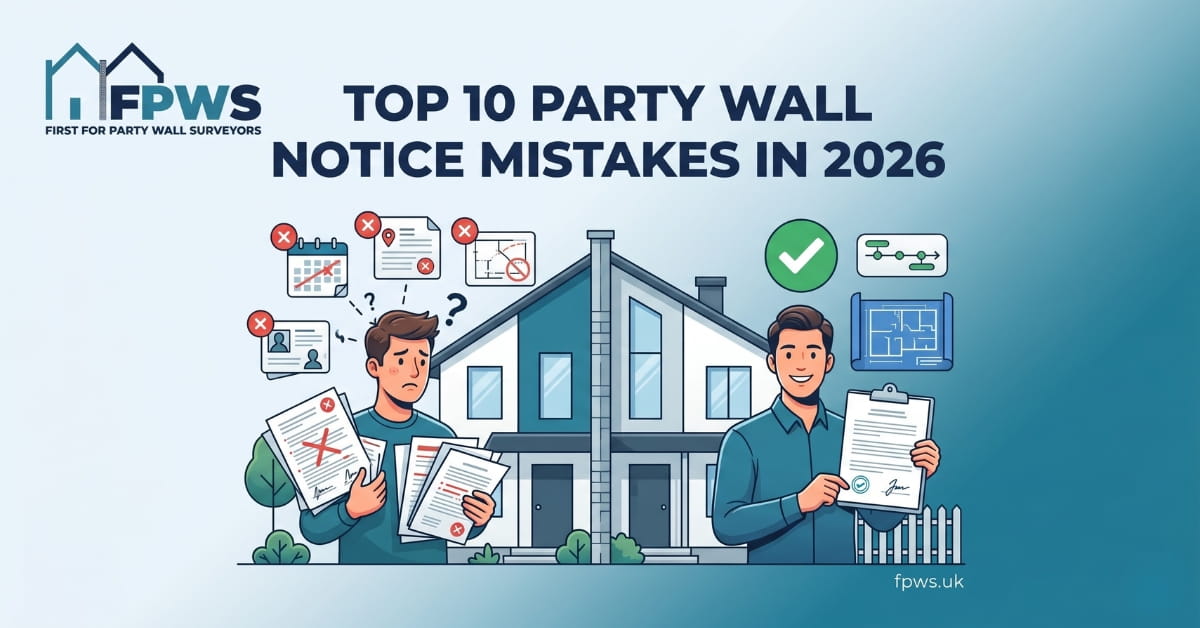
The Top 10 Party Wall Notice Mistakes in 2026
1. Not Serving a Notice at All
This is the biggest mistake of all.
Many homeowners think their builder, architect, or planning permission covers it. They don’t. Planning permission and Building Regulations are separate from the Party Wall Act. Following one does not cover the other.
Some people skip the notice to “keep things friendly” with a neighbour. But this can backfire badly. If you start work without a valid notice, your neighbour can apply to the court for an injunction. That order can stop your work overnight. Your builders sit idle. Your costs climb.
How to avoid it: If your work touches a shared wall or sits close to a boundary, assume the Act applies. When in doubt, ask a party wall surveyor before you lift a single tool.
2. Serving the Wrong Type of Notice
The Act has three main types of notice. Sending the wrong one makes your notice invalid.
Here is the simple breakdown:
- Section 1 (Line of Junction notice): for new walls on or along the boundary line.
- Section 3 (Party Structure notice): for work to a shared wall, floor, or structure, like a loft conversion or removing a chimney breast.
- Section 6 (Adjacent Excavation notice): for digging near your neighbour’s home, usually within 3 or 6 metres and below their foundations.
Some jobs need more than one notice. A basement extension, for example, may need both a Section 3 and a Section 6 notice.
How to avoid it: Match the notice to the work. If your project is complex, get expert eyes on it first.
3. Getting the Notice Period Wrong
Every notice has a minimum waiting time before you can start work. Get this wrong and your notice fails.
The rules are simple but strict:
- Section 3 (party structure): at least 2 months before work begins.
- Section 1 and Section 6: at least 1 month before work begins.
This is the “lead-in” time. It gives your neighbour space to respond.
Many people serve a notice and start digging two weeks later. That is far too soon. The clock has not run out.
How to avoid it: Count your dates carefully. Build the full notice period into your project timeline from day one.
4. Forgetting to Notify Every Adjoining Owner
You must serve notice on all adjoining owners. Not just one. Not just the person you see in the garden.
This often catches people out. An adjoining owner can include:
- The freeholder next door
- Long leaseholders (leases over one year)
- Several flat owners in a converted building
- Owners on both sides, if your work affects two boundaries
Miss one owner and your notice is incomplete. The whole process can unravel.
How to avoid it: Check the ownership of every affected property. A title search at HM Land Registry helps. A surveyor can confirm exactly who must be served.
5. Writing a Vague Work Description
A party wall notice must clearly describe the work. A vague notice invites confusion, worry, and disputes.
“Some building work” is not enough. Your neighbour needs to understand what you plan to do.
A good notice states:
- The address where the work will happen
- A clear description of the proposed work
- The name and address of the building owner
- When you intend to start
Vague notices often get challenged. That delays everything.
How to avoid it: Be specific and honest. Describe the work plainly, so your neighbour knows exactly what to expect.
6. Leaving Out Plans for Excavation Notices
This mistake is specific to Section 6 (excavation) notices, but it is a common one.
If you dig near your neighbour’s home, your notice must include plans and sections. These drawings show:
- The depth of your excavation
- The location of the digging
- Whether you plan to underpin or strengthen their foundations
Without these, a Section 6 notice is not valid. The waiting period does not even start.
How to avoid it: Ask your architect or structural engineer for proper plans and sections. Attach them to the notice before you serve it.
7. Serving the Notice Too Late
Some people leave the notice until the last minute. Then they panic when the project stalls.
Remember the lead-in time. You may need to wait up to two months after serving the notice. If a dispute arises, surveyors must be appointed, which adds more time.
Serving late can push your build back by weeks or months.
How to avoid it: Serve your party wall notice early. We suggest doing it as soon as your plans are settled, well before your builder’s start date.
8. Putting Wrong Names or Addresses on the Notice
Small errors cause big problems. A notice with the wrong name, wrong address, or missing date can be invalid.
We have seen notices addressed to a previous owner. We have seen the wrong house number. We have even seen notices with no start date at all.
These errors seem minor. But they can void the whole notice. Then you must start again.
How to avoid it: Double-check every detail. The building owner’s name, the neighbour’s name, both addresses, the work description, and the date must all be correct.
9. Misreading Your Neighbour’s Silence as Consent
This is one of the most misunderstood parts of the Act.
After you serve a notice, your neighbour has 14 days to respond. They can do one of three things:
- Consent in writing (the simplest outcome)
- Dissent and agree to use one agreed surveyor
- Dissent and appoint their own surveyor
If your neighbour says nothing for 14 days, that is not consent. The law treats silence as a dispute (deemed dissent).
Many building owners assume “no reply means yes.” That is wrong. You cannot just carry on.
When a dispute arises, surveyors must be appointed. They then produce a party wall award. This is a legal document that sets out how the work will proceed and protects both sides.
How to avoid it: Never treat silence as a green light. If there is no reply, the next step is a formal one. A surveyor can guide you through it.
10. Letting the Notice Expire (Then DIY-ing the Whole Thing)
A party wall notice is only valid for 12 months. If your work does not start within that time, the notice lapses. You must serve a fresh one.
This trips up people whose projects get delayed by planning, funding, or builder availability.
The bigger lesson? Many of these ten mistakes happen when people try to handle everything alone. The DIY route feels cheaper. But one invalid notice can cost far more in delays and legal fees.
How to avoid it: Track your notice dates. And if the process feels complex, bring in an expert early.
How a Party Wall Surveyor Helps You Avoid These Mistakes
A good party wall surveyor does more than fill in forms. They protect your project and your peace of mind.
Here is what we do at FPWS:
- Confirm whether the Party Wall Act applies to your work
- Identify every adjoining owner who must be served
- Prepare and serve valid, correctly worded notices
- Draw up a schedule of conditions to record your neighbour’s property before work starts
- Negotiate and prepare the party wall award
- Step in early to keep things calm and avoid disputes
Our members are RICS-regulated and fully insured. We act for building owners and adjoining owners alike. So whether you are starting work or you have just received a notice, we can help.
You can learn more or speak to a specialist at FPWS (First for Party Wall Surveyors). We offer friendly, free initial advice on how best to handle your party wall matter.
A Few Final Tips Before You Serve Your Notice
Before you send anything, run through this short checklist:
- Confirm the work is notifiable under the Act
- Choose the correct notice type (Section 1, 3, or 6)
- List every adjoining owner
- Describe the work clearly and accurately
- Attach plans for excavation notices
- Allow the full notice period (1 or 2 months)
- Check every name, address, and date twice
- Plan for the 14-day response window
- Keep written consent on file
Tick all of these off, and you are in a strong position.
Building work is stressful enough. A clean party wall notice removes one big worry from your plate.
Frequently Asked Questions
1. What happens if I don’t serve a party wall notice?
If you skip a required notice, your neighbour can seek a court injunction to stop your work. You may also be fully liable for any damage to their property. Always serve a valid notice before notifiable work begins.
2. How long does a party wall notice take?
It depends on the notice type. A party structure notice needs at least 2 months’ notice. A line of junction or excavation notice needs at least 1 month. If a dispute arises, allow extra time for surveyors to agree on an award.
3. Can my neighbour refuse a party wall notice?
Your neighbour cannot stop lawful work. But they can dissent, which triggers a dispute under the Act. Surveyors are then appointed to produce a party wall award. This sets fair terms so the work can proceed safely.
4. Do I need a party wall notice for a loft conversion?
Often, yes. If your loft conversion involves work to a shared wall, such as inserting beams or removing a chimney breast, a Section 3 party structure notice is usually required.
5. What if my neighbour ignores my party wall notice?
Silence is not consent. If your neighbour does not respond within 14 days, the law treats this as a dispute. You should then move to appoint a surveyor rather than simply starting work.
6. Can I write my own party wall notice?
You can. But the notice must meet strict legal requirements. A single error, such as the wrong owner or a missing plan, can make it invalid. Many people use a party wall surveyor to get it right first time.
7. How long is a party wall notice valid for?
A party wall notice is valid for 12 months. If your work has not started within that period, the notice lapses, and you must serve a new one.
Get Expert Help With Your Party Wall Notice
Getting your party wall notice right is the foundation of a smooth project. Avoid these Top 10 Party Wall Notice Mistakes, and you save yourself time, money, and stress.
If you feel unsure at any stage, you do not have to face it alone.
The experienced team at FPWS (First for Party Wall Surveyors) is here to guide building owners and adjoining owners across England and Wales. Reach out for clear, honest, expert advice, and let’s get your project moving the right way.